
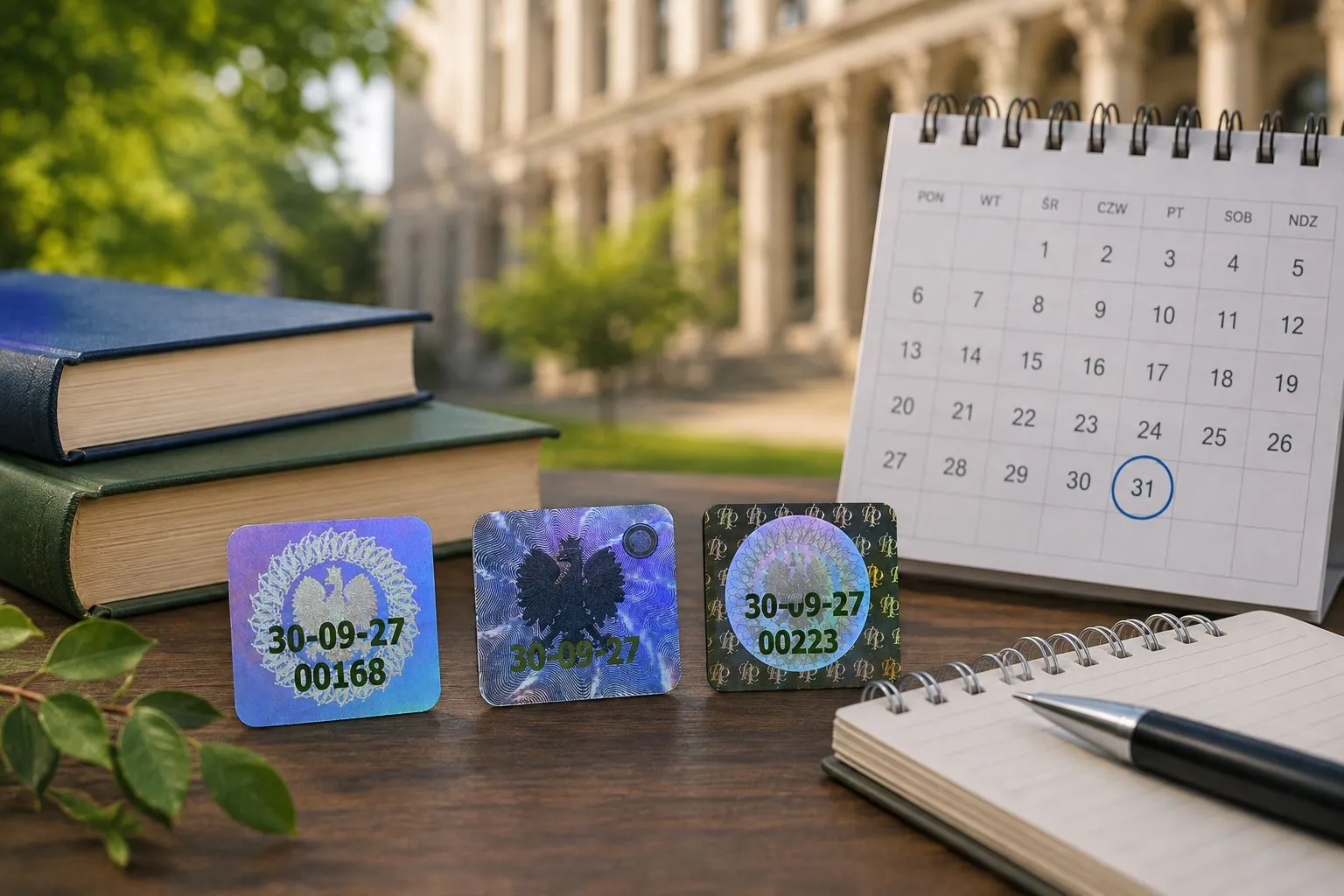
Hologram stickers are the stamps and seals of the 21st century. They serve to authenticate documents such as student IDs (ELS), international cards (ISIC), and other important documents, thanks to which students, although not only them, obtain discounts and privileges. The hologram itself is a small piece of foil subjected to laser processing to obtain a mysterious, unique pattern. The hologram print element includes the eagle symbol and the date indicating the document’s expiration date, which becomes transparent after applying the sticker. After the expiration date, the student is obliged to go to the university dean’s office for a new sticker. This guarantees their student rights. Sometimes ELS, as is the case with UKSW, the University of Warmia and Mazury, or the Higher School of Finance and Management in Warsaw, is also a city card and payment method. Higher education institutions in Poznań, Łódź, Kraków, and other cities have also created opportunities for their students to use such services.
The semester sticker for ELS is received by the student at the university’s dean’s office. If the student tears off the sticker, they will destroy it and thereby lose their student discounts. This one-time use of the stamp is of course intended to prevent fraud, and among the safeguards of the hologram, the most important one is the blocking of the so-called „honey paste”.Using these holographic stickers for any kind of benefit (e.g., a discount ticket) is illegal and punishable by law. Collectable holograms are just nice stamps, and collecting them is like a philatelic passion.
No, if the identity card itself is not an official document that confirms identity and affiliation with a higher education institution. In large cities like Warsaw or Kraków, as well as Łódź, young people fascinated by student life collect stickers that resemble holograms of ELS from various academic institutions. Thanks to their collections, they become, for a moment, at home, simultaneously students of the University of Warsaw, SGGW, the famous AGH in Krakow known throughout Poland, or the atmospheric Jan Długosz Academy in Częstochowa. Likewise, former students are eager to collect the insignia of other universities, and perhaps thanks to a collector’s passion they will once again start studying at university.
A student who loses their student ID can have it issued with a Warsaw City Card at one of the many Passenger Service Points. To obtain the card, a certificate from the university and the code of the lost student ID are required.
The Warsaw City Card issued by the Municipal Transport Authority is an electronic ticket containing information about the discounts available for public transport tickets. Students using the Warsaw public transport system can obtain a card with statutory student discounts after presenting a valid ID with the current ELS sticker. In the event of loss of the ID, the student can obtain a Warsaw City Card by presenting a certificate from the university confirming their student status and thus the right to the discounts available, as well as the code of the lost document. It is worth noting that students from public and private universities are entitled to 50% discounts on monthly and one-time tickets until the age of 26.
ELS sticker 31-03-27 – buy now to complete your collection!

The Hologramykolekcjonerskie24.com editorial team has been specializing in the topic for over 10 years. collectible holograms and patterns related to educational documents. We are preparing practical guides on ELS student holograms, doctoral ELDs and school-based ones, and their dates, variants, safeguards, and histories.
The published content is based on reliable sources regarding the Polish education system, applicable legal regulations, regulations of the relevant ministries, and official information provided by universities, schools, and public institutions. We regularly update the materials to reflect changes in regulations, document templates, and policies applicable in Polish education.
The website is informational and collector-oriented and is not affiliated with any university, school, ministry, or other public institution.